

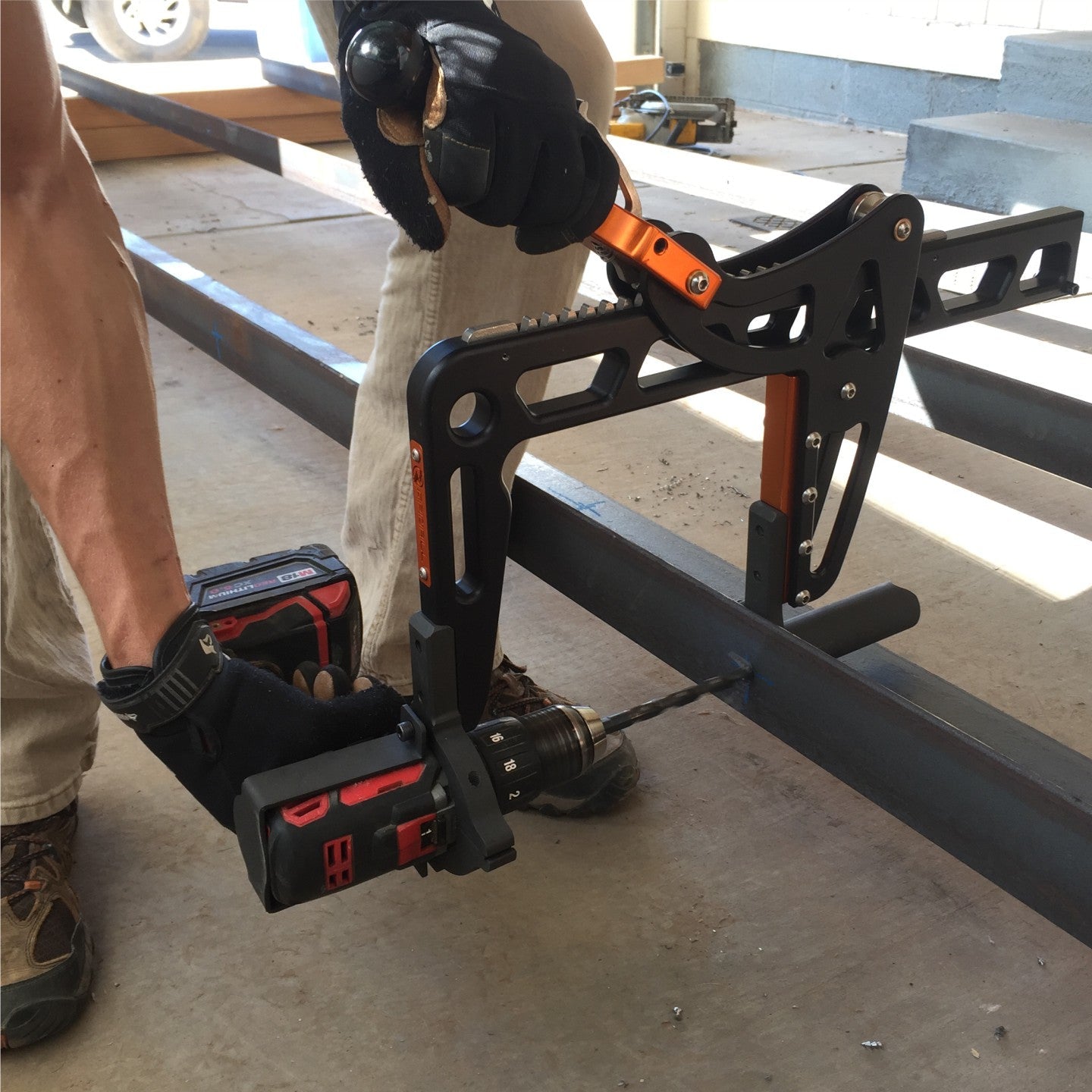
How to Drill Thick Steel, I-Beams, and Channel Iron When a Mag Drill Won’t Stick
Drilling through heavy steel is usually simple—as long as you have a flat, clean surface for a mag drill. But in the field, real steel is dirty, uneven, angled, galvanized, curved, painted, or covered in mill scale. That’s when the magnet won’t hold, production stalls, and crews end up trying unsafe workarounds.
What This Blog Covers
In this blog, you’ll learn why mag drills fail on certain surfaces and what your real options are when the magnet won’t stick. We’ll cover how to safely and efficiently drill through thick steel, I-beams, channel iron, and tubing using the clamp-on method—without resorting to grinding, risky angles, or guesswork.
- Identify the most common “no-stick” scenarios
- Use the proper clamp-on technique step-by-step
- Choose the right bits for thick steel
- Apply over 1,000+ lbs of controlled drilling force using a mobile drill press like Rapidrill
- Drill clean, safe, accurate holes without surface prep or flat steel
If you deal with unpredictable field conditions, this guide shows you how to get professional drilling results anywhere on the structure.

Why Mag Drills Fail on Real-World Steel
Mag drills work only when they have:
- A flat, level, thick, clean steel surface
- No coating, paint, or galvanizing
- No curvature or crown
- Enough space to sit level and clear the feed handle
Jobsite steel rarely meets these conditions.
Common “No-Stick” Scenarios
- I-beam flanges with a crown or uneven surface
- Channel iron with narrow lips
- Galvanized or powder-coated steel
- Thin structural members
- Round pipe or tubing
- Angled steel or overhead locations
Your Options When the Magnet Won’t Grab
When mag drills fail, crews typically try one of four things:
1. Using a Cordless Drill Freehand at an Angle
Fast, but dangerous and inaccurate. Little feed force, bit walking, overheated bits, and high wrist torque.
2. Grinding a Flat Spot for the Magnet
Time-consuming, removes metal from the structure, and still may not provide a reliable magnetic hold.
3. Temporary Clamps or Makeshift Fixtures
Unstable, unsafe, and inconsistent. Often requires two people and creates more risk than it solves.
4. Switching to a Clamp-On Mobile Drill Press (The Best Field Solution)
This is where a tool like Rapidrill shines—giving you drill-press power anywhere on the steel, without needing a flat magnetic surface.
The Clamp-On Method: How Rapidrill Solves the Problem
Rapidrill was built specifically for situations where a mag drill is impossible to use. It clamps onto beams, channel, pipe, tubing, and angles—anywhere you can physically grip steel. Combined with a cordless drill, it delivers over 1,000 lbs of controlled drilling force, making it a true field-capable drill press.

Step-by-Step: How to Drill Thick Steel When Your Mag Drill Won’t Stick
Step 1 — Position the Clamp
Set the Rapidrill clamp on the beam flange, channel web, or pipe where you need the hole. Make sure you have enough room to crank the feed handle without interference.
Step 2 — Tighten the Clamp Securely
Tighten the clamp until the tool cannot wiggle side-to-side. A solid clamp is what converts your movement at the handle into straight, controlled feed force at the bit.
Step 3 — Choose and Install the Right Bit
- Annular cutters for large holes in thick plate.
- Cobalt twist bits (M35/M42) for general heavy steel drilling.
- Step bits for clean pilot holes and enlarging existing holes.
Step 4 — Apply Controlled Feed Pressure
Use the Rapidrill feed lever to apply steady pressure. This is the big advantage over handheld drilling: drill-press-style force, but on the steel that’s already erected.
Step 5 — Back Out Cleanly
Once you’ve broken through, ease off the pressure and reverse the drill to back the bit out. The clamp keeps everything aligned, reducing the chance of grabbing or binding.
Why the Clamp-On Method Beats Every Workaround
1. No Surface Prep
No grinding required. Painted, galvanized, rusty, or angled steel is not a problem.
2. Safer Than Freehand Drilling
Two-hand control reduces wrist torque and kickback. The tool holds the drill; you control the feed.
3. Works Anywhere on the Structure
Overhead, at an angle, on tubing or channel—if you can clamp it, you can drill it.
4. Faster Than Modifying the Steel
Clamp, drill, move on. No more burning time grinding flats just to get a magnet to hold.
The Phoenix Substation Moment
While drilling on pipe in a Phoenix substation, it became obvious to me: mag drills only work when conditions are perfect. Field steel is never perfect. That realization pushed the modernization of Rapidrill—bringing back and upgrading a tool that solves a problem steel crews have dealt with for decades.
Watch Rapidrill in action:
Best Bits for Thick Steel
- Cobalt bits (M35/M42) for hard structural steel.
- Annular cutters for large-diameter holes.
- High-pressure cutting fluid to reduce heat and extend bit life.
For many jobs, Rapidrill PRO paired with quality cobalt bits is enough to handle the bulk of your field drilling.
When a Mag Drill Still Makes Sense
This isn’t an anti-mag-drill article. Mag drills are still the best option when:
- You have flat plate or thick, clean flanges.
- You’re in the shop with controlled conditions.
- You have clearance and a comfortable working height.
Rapidrill simply fills the other 60% of the jobsite scenarios—the ones where real-world steel makes a magnet unrealistic.
Not sure which tool is right for which scenario?
Final Thoughts
Jobsite steel isn’t perfect, and your drilling setup shouldn’t depend on perfect conditions. When a mag drill won’t stick, a clamp-on mobile drill press gives you the mobility, safety, power, and precision you need to keep moving.
If your crew constantly runs into painted, angled, or thin steel, adding Rapidrill to the lineup is one of the fastest ways to reduce frustration and keep production moving.
Share:
The Real-World Mag Drill Alternative